


What Is a Video Resume and Why Employers Watch It
A video resume is a short, self-recorded introduction (typically 60–90 seconds) where you present your background and enthusiasm on camera. Think of it as an elevator pitch brought to life. It complements your text resume by letting employers see your face and hear your voice.
For example, Morgan McKinley explains:
a video resume is a short, pre-recorded introduction… Think of it as a way to bring your CV to life—giving hiring managers a chance to see your personality, communication style, and enthusiasm before even meeting you
Why are employers embracing videos?
Hiring data show that video adds real value.
- A Vault Inc. survey found 89% of employers would watch a video resume if it were submitted.
- 52% of employers value the ability to assess presentation and confidence via video.
- Video resumes help recruiters quickly gauge soft skills like charisma, communication, and cultural fit.
Video resumes are also on-trend.
- 79% of hiring managers say video is gaining importance.
- Platforms like TikTok and LinkedIn are building resume-video features.
- Video interviewing jumped 67% from 2020–2021, and 60% of companies plan to keep using it.
The takeaway: video in hiring is no fad – it’s a major hiring trend.
Traditional Resume: Strengths and Limitations
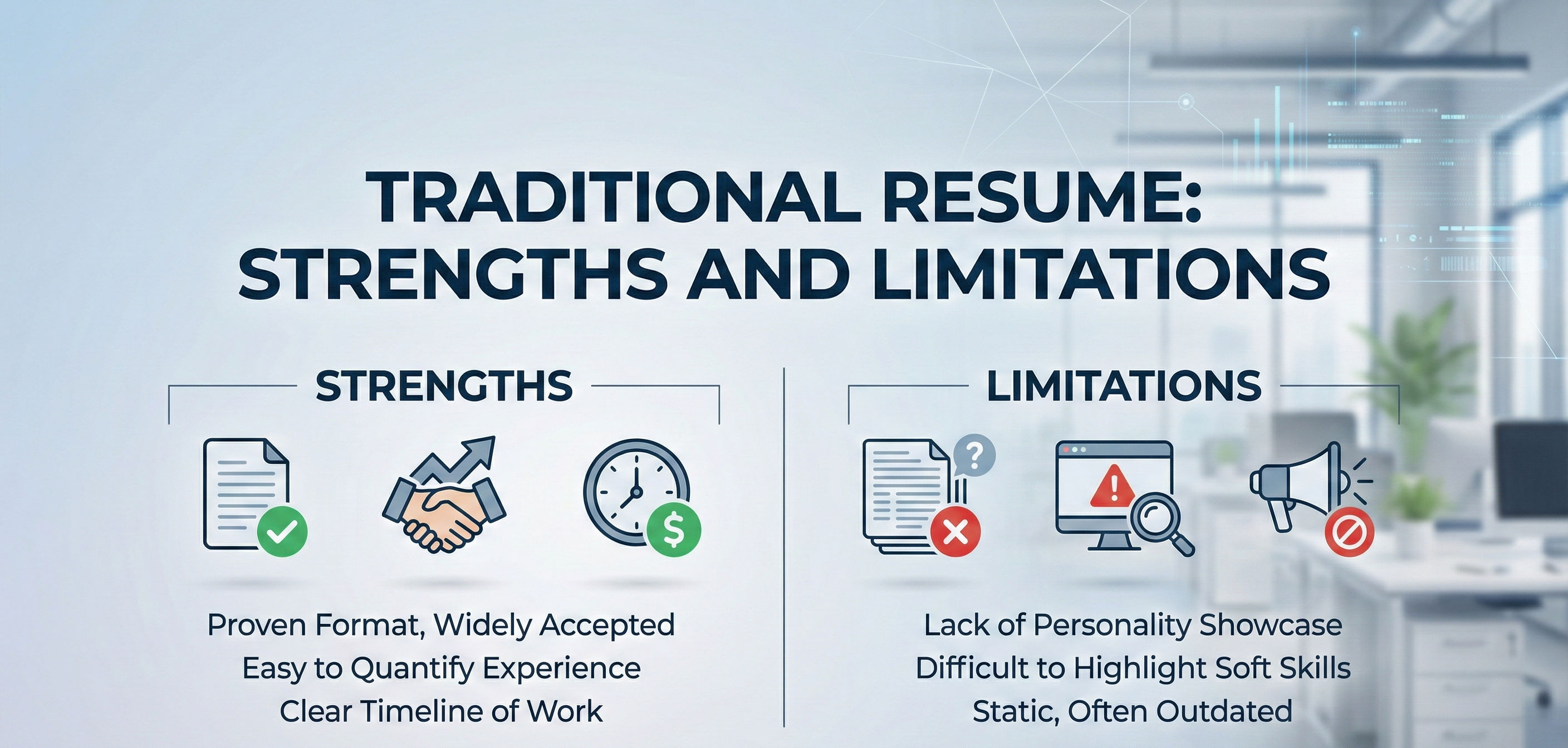
Strengths of a Traditional Resume
- Universally required and accepted in almost every hiring process.
- Easy for recruiters and ATS to scan, parse, and store in databases.
- Provides a clear, structured snapshot of your experience, skills, and education.
- Works especially well for technical or conservative fields where formal documentation is preferred.
Limitations of a Traditional Resume
- Looks similar to many other resumes, so it’s easy to blend in.
- Text alone can’t show communication skills, confidence, or personality.
- Creative or interpersonal strengths aren’t showcased effectively.
- ATS ignores anything beyond text, so videos, websites, or social profiles aren’t captured.
When to Use Each Format

Video resumes are powerful, but they’re not a one-size-fits-all solution. Use them strategically alongside (not instead of) your traditional resume. Industry plays a big role:
Creative & Marketing Roles
If you’re in design, media, advertising, or any creative field, a video resume can be a great asset. It lets you demonstrate creativity. For example, a marketing applicant might overlay graphics showing campaign results while narrating their achievement. Digital Reference advises: “Creative industries (design, content, marketing) – use both. Your resume outlines skills, your video shows creativity and energy”.
Tech Startups & Remote Jobs
Video resumes also shine in tech startups or remote-first companies. These teams often hire asynchronously and value digital communication skills. A brief video intro can give a strong first impression of how you handle on-screen presentation. “A video resume gives a strong first impression for asynchronous teams and shows how you’d present yourself on camera”.
Sales & Client-Facing Roles
Positions in sales, PR, consulting, or customer success require confidence and presence. A candidate video can showcase these: a clear, enthusiastic tone can prove your comfort with face-to-face pitching. Employers can directly judge your communication style. Digital Reference notes you can “demonstrate confidence, clarity, and communication with a strong video introduction” in such roles.
Early Career or Career Changers
If your written resume is thin on experience, a video can fill gaps by highlighting your personality, potential, and passion. Younger job seekers (Gen Z) are especially comfortable on video: 61% of them believe videos could replace cover letters. Use your story (e.g. volunteer projects, internships) in a video to stand out.
When to stick with traditional format
Some situations still call for a classic resume:
ATS and Formal Industries
If the job requires uploading to an ATS or is in a highly regulated field (law, finance, academia, civil service, healthcare), always include a strong text resume. Video resumes can’t be scanned by ATS, so they should only supplement your PDF. Digital Reference warns that if you apply through an ATS or to a conservative company, your video “should accompany, not replace, your document”.
Employer Instructions
Always check the posting. If it explicitly asks for a written resume and cover letter (and no video), follow instructions. You can still make a video on the side, but be sure your “cover letter is what” they asked for first.
Job Application Portals
Many online job sites allow only file uploads for resumes. In that case, use the conventional resume builder tools to format your résumé (choose templates for resumes and cover letters) and then try to include a link to a video in a remarks section or follow-up email.
In practice, the best approach is often both
Submit your polished written resume through the official channels, and also share a video resume link in your cover letter, email, or LinkedIn profile. For example, one recommended strategy is:
- Apply with your traditional resume via the company’s ATS or job portal.
- In your cover letter or email signature, include a brief CTA link to your video. For instance: “View my 90-second video introduction here: [Video Resume Link]”.
- Upload the video (or a clip of it) on your LinkedIn Featured section or a personal site.
This way you satisfy the ATS-friendly resume requirements while also giving recruiters the option to click and watch your video if they want a deeper look
Video Resume Statistics & Trends
- 67% of Hiring Managers say video resumes help assess candidates more effectively.
- Video resumes offer a 10% higher callback rate.
- 89% of Employers would watch a video resume.
- 79% of Managers say video is growing in importance.
- 61% of job seekers think video could replace cover letters.
- Video interviewing jumped 67%, and 86% of employers use it for first interviews.
2025 trend: Video resumes are becoming a standard supplement to written resumes.
How to Create a Standout Video Resume

Plan Your Script (30–90 seconds)
- Start with a hook.
Example:
Three years ago, I helped a startup triple their social media engagement. Today, I want to do the same for your team. - State who you are.
- Highlight 2–3 achievements.
- Tailor your pitch to the company.
Structure Your Content
- Intro (5–10 sec): Name and profession.
- Skills & Achievements (20–40 sec): Quick highlights.
- Personality Glimpse (10–15 sec): A clip of a hobby or volunteering.
- Call-to-Action (5–10 sec): Invite them to reach out.
Set Up the Scene
- Use good lighting and a quiet space.
- Shoot at eye level.
- Wear professional clothing.
Delivery Matters
- Speak clearly.
- Maintain natural energy.
- Record multiple takes.
Edit and Polish
- Trim filler words.
- Add captions.
- Keep the video 60–90 seconds.
Optimize for ATS
- Include a clickable video thumbnail in your PDF.
- Add your video script as text so ATS picks up the keywords.
Top Video Resume Tools and Platforms
Fortunately, many tools can help you create a great video resume—even if you’re not a video pro. Here are some popular options:
Video-Making Platforms
Services like Biteable, Animaker, and Powtoon offer templates specifically for video resumes. They let you drag-and-drop clips, text, and graphics.
Recording Tools
Tools like Loom or Zoom (and their mobile app) can record you directly from your computer or phone. For a simple, straightforward intro, these work well.
General Video Editors
If you want more control, try video editors like Canva or WeVideo. Canva (known for graphics) has a video mode with many templates, stock assets, and text animations. WeVideo lets you add effects like green screen or multi-track edits.
SpotEleven: Video Resumes + Verified Credentials (All in one platform)
SpotEleven is a job platform that connects top talent with employers through short video resumes and rich online portfolios instead of just static PDFs. It is built for candidates who want to showcase personality and for employers who want faster, more accurate talent discovery.
Key Features Candidates Will Love
Video resumes: Candidates record brief video introductions so communication skills, confidence, and personality are visible from the first impression.
Customizable portfolios: Users can showcase projects, achievements, and skills in a visual, portfolio-style profile that goes beyond a traditional CV.
Intelligent matching: A swipe-based, value-and-skill-driven matching system helps candidates discover roles aligned with their interests, not just keywords.
Verified Credentials + Video (SpotEleven x Certopus )
SpotEleven integrates verifiable digital credentials, including Certopus-issued certificates, directly into candidate profiles. These credentials are backed by blockchain-powered verification, so employers can instantly validate that a candidate truly holds specific certifications. In practice, a SpotEleven profile becomes a video resume plus a trusted credential wallet, combining on-screen presence with tamper-proof proof of skills.
Integrating Video with Your Application
Remember, most job applications still start with text, so blend formats. A strong cover letter is still important. You might write a regular cover letter (or use a cv letter template) but mention your video. Example line for a cover letter:
I’ve attached my resume and cover letter. To get a better sense of my communication style and enthusiasm, please view my 90-second video introduction here: [Video Link]
If the application portal allows only uploads, consider uploading your traditional resume and then emailing the video link to the recruiter or mentioning it in an interview. On LinkedIn, you can add your video to the Featured section or use the “Cover Story” feature to serve as a mini video resume.
Frequently Asked Questions
1. What are the resume trends for 2025?
Resumes in 2025 are tighter, cleaner, and focused on real skills instead of long descriptions. Recruiters want clear summaries, measurable achievements, and links to portfolios or short video intros. ATS-friendly formatting still matters, but personality, clarity, and proof of work carry more weight than keyword stuffing or fancy designs.
2. What is the difference between a traditional resume and a video resume?
A traditional resume relies on text to outline experience, skills, and education in a structured way. A video resume shows how you communicate, speak, and present yourself. One is built for ATS and quick scanning, while the other helps employers see confidence, personality, and presence, which can boost engagement when used alongside a written resume.
3. What are 2025 resume buzzwords to avoid?
Avoid empty terms like hardworking, passionate, dynamic, results-driven, team player, and motivated. These words don’t tell recruiters anything specific. In 2025, hiring managers care more about real examples, numbers, tools, and outcomes. Replace vague adjectives with clear accomplishments that prove what you did and how it actually made an impact.
4. Are nearly 99% of Fortune 500 companies using ATS?
Yes, almost every Fortune 500 company uses ATS to sort applications before a recruiter sees them. These systems scan for clean formatting, relevant keywords, and clear job alignment. If your resume isn’t optimized for ATS, it can be filtered out early, even if you’re fully qualified for the role.
Ready to stand out? Book a demo