

How to Get Noticed by Recruiters Without Applying to Every Job
You can get noticed by recruiters without applying to every job by making your skills, proof of work, and role focus discoverable through a strong profile, a portfolio that proves your claims, and a platform built for passive discovery, like SpotEleven’s talent discovery model. Applying still matters, but it shouldn’t be your only strategy.
Why Doesn’t Applying to More Jobs Get You Noticed?
Sending out 20, 30, or 50 applications doesn’t scale the way it feels like it should, and the data on how recruiters actually screen candidates explains why. In The Ladders’ 2018 eye-tracking study, recruiters spent an average of 7.4 seconds on an initial resume review. The study found that recruiters quickly scanned elements such as job titles, company information, dates, and education before deciding whether to continue reading.
This shift matters more now because hiring itself has moved past credential-first screening. NACE’s 2026 Job Outlook survey found 70% of employers now use skills-based hiring for entry-level roles, up from 65% the year before, and TestGorilla’s State of Skills-Based Hiring research shows overall adoption climbed from 56% in 2022 to 85% in 2025. Recruiters are filtering on demonstrated skill, not just job history, more than ever.
A few things compound that problem:
- ATS filtering. If your resume or profile lacks the exact keywords a recruiter searched for, it may never reach a human.
- Generic applications. Applying to dozens of roles usually means sending the same resume everywhere, instead of one tailored to a specific role.
- Volume competition. The most visible postings attract the largest applicant pools; you’re one of hundreds by design.
- Mismatched applications. Applying out of desperation to roles you’re over- or under-qualified for leads to fast, automatic rejections.
Applying is still worth doing for roles you’re a strong fit for. The problem is treating it as your only channel.
How Do Recruiters Actually Find Candidates?
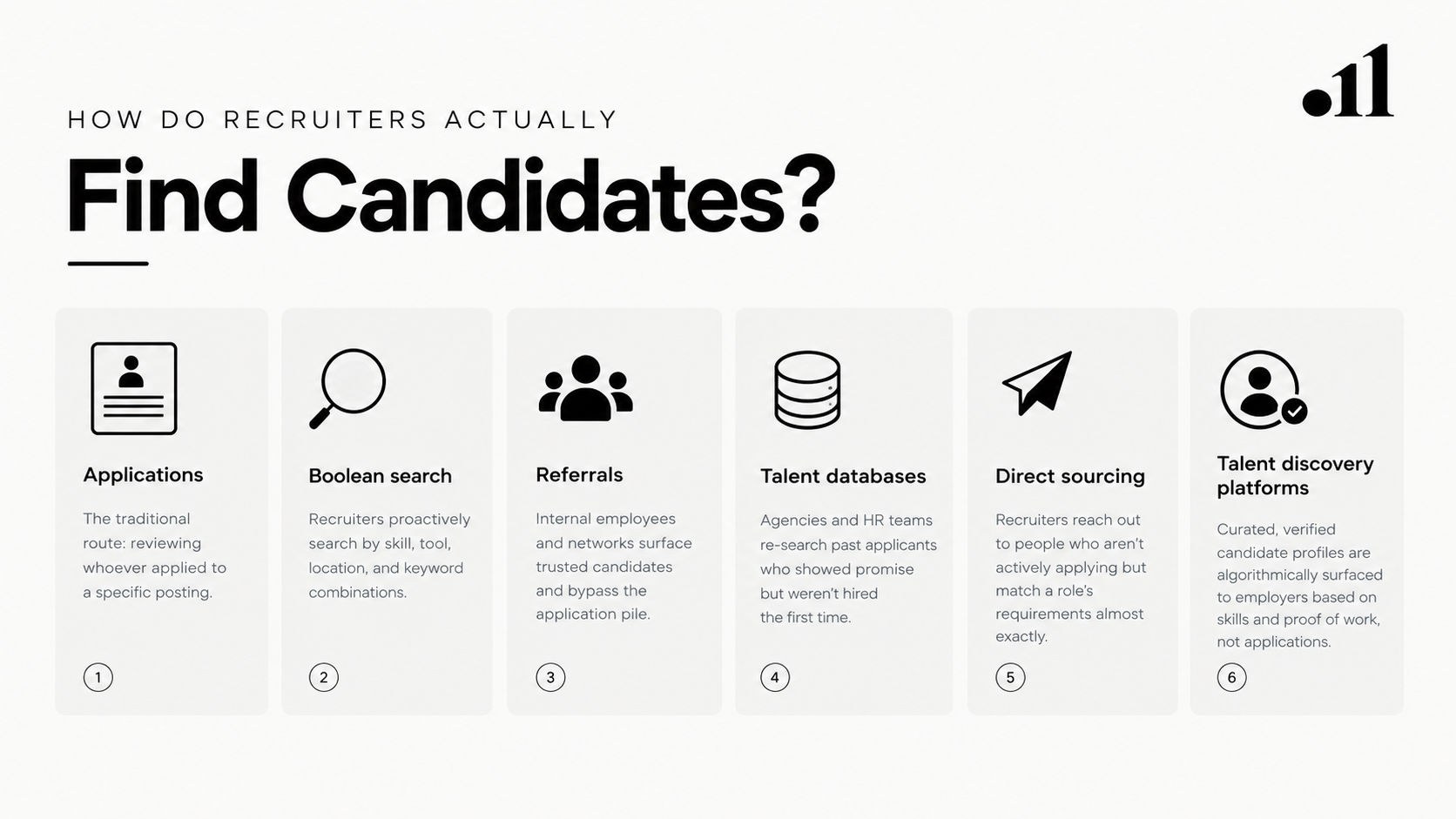
LinkedIn’s Economic Graph data shows 26% of paid job listings in 2024 didn’t require a degree at all, up from 20% in 2020, meaning a growing share of recruiter searches filter by skill and portfolio evidence rather than credentials.
Job boards are one channel among several, and often not the primary one for roles that matter:
- Applications, the traditional route: reviewing whoever applied to a specific posting.
- Boolean search on professional platforms: recruiters proactively search by skill, tool, location, and keyword combinations.
- Referrals: internal employees and networks surface trusted candidates and bypass the application pile entirely.
- Talent databases: agencies and HR teams re-search past applicants who showed promise but weren’t hired the first time.
- Direct sourcing: recruiters reach out to people who aren’t actively applying but match a role’s requirements almost exactly.
- Talent discovery platforms: curated, verified candidate profiles are algorithmically surfaced to employers based on skills and proof of work, not applications. This is the model SpotEleven is built on.
The Discoverability Framework: 7 Steps to Get Found
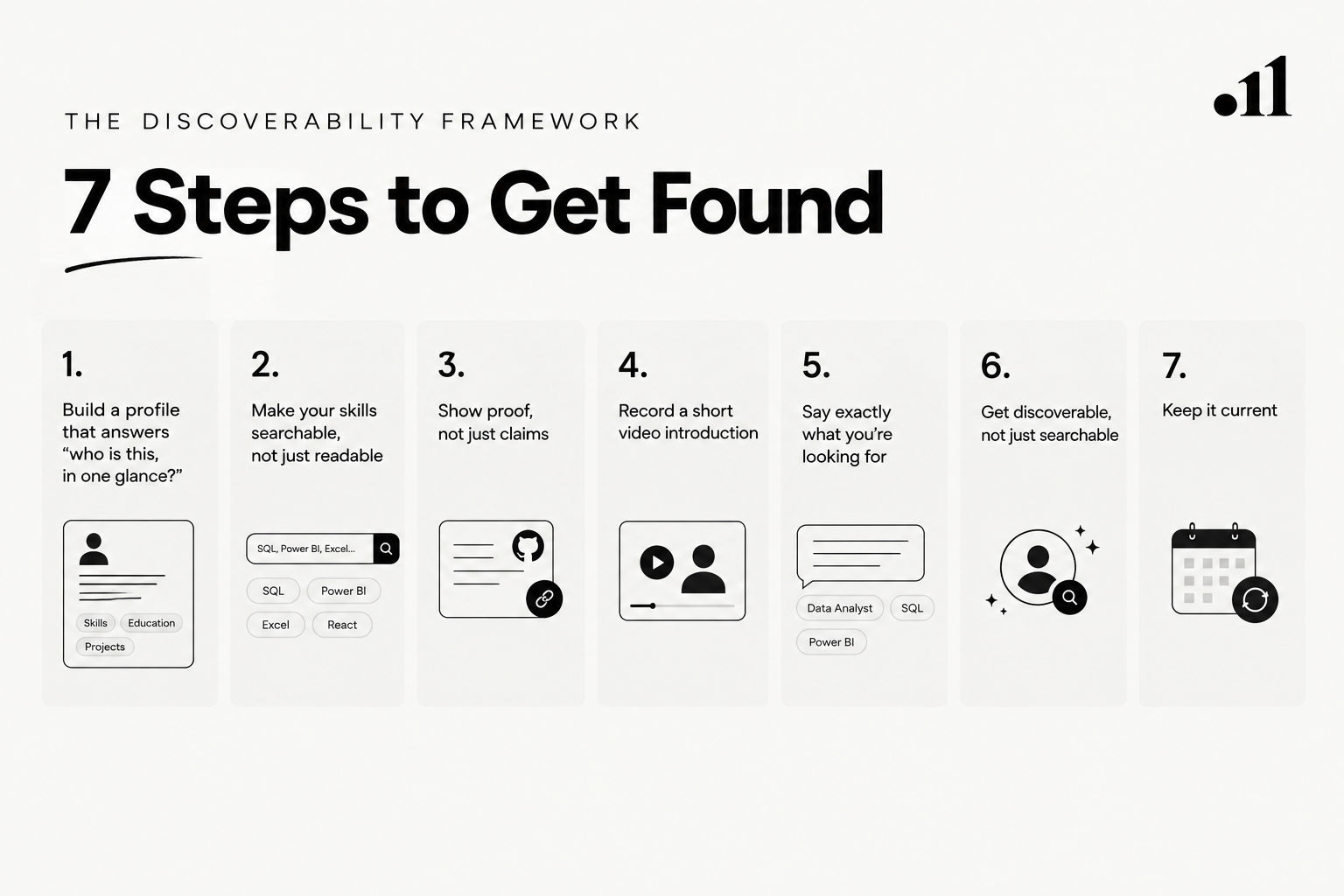
1. Build a profile that answers “who is this, in one glance?”
A recruiter should understand your professional identity in seconds, not minutes: core function, key skills, education, certifications, and 1–2 tangible projects, up top.
For freshers: skip trying to pad experience. Lead with academic projects, hackathons, open-source contributions, and internships; that’s what a fresher’s version of “proof” looks like.
2. Make your skills searchable, not just readable
Recruiters filter by hard, specific terms: SQL, Power BI, Excel, SEO, React, Figma, not soft descriptors like “team player” or “excellent communicator.” If a skill isn’t named explicitly, it doesn’t exist in a keyword search, no matter how true it is.
3. Show proof, not just claims
Anyone can list “SQL” on a profile. Link the actual output: a GitHub repo, a case study, a capstone project, a dashboard.
4. Record a short video introduction
A text resume is flat. A 60–90 second video shows communication style, confidence, and personality alongside technical credentials, and it’s the core differentiator of SpotEleven’s model specifically.
5. Say exactly what you’re looking for
“Open to anything” gets recruiters to skip past you, because you don’t fit a mental bucket they’re filtering for. Compare:
| Vague | Specific |
|---|---|
| ”Looking for a growth opportunity" | "Aspiring data analyst focused on entry-level roles using SQL, Excel, and Power BI" |
| "Open to anything in tech" | "Frontend fresher, React and Figma, remote or Delhi NCR” |
6. Get discoverable, not just searchable
Traditional job search puts 100% of the chasing on you. Talent discovery flips part of that: build one strong, verified profile once, and let relevant employer searches surface it, instead of resubmitting the same information to every posting.
7. Keep it current
An outdated profile reads as a stalled career to both human recruiters and ranking algorithms. New certification, new project, new skill: update it the same week, not the same year.
Traditional Job Search vs. Talent Discovery
| Traditional Job Search | Talent Discovery | |
|---|---|---|
| Who searches | Candidate searches listings | Employers search relevant talent |
| Effort per role | Manual application every time | One profile, built once |
| What’s submitted | A static resume | Skills, portfolio, and credentials up front |
| Response time | Days to weeks, if at all | Employers reach out directly on match |
| What it’s driven by | Application volume | Skill match and verified proof |
These aren’t mutually exclusive; keep applying to high-priority roles while building a profile that lets other relevant employers find you passively.
How SpotEleven Fits Into This
SpotEleven is built around the talent discovery model above, not the application model. The workflow:
- Build your profile: your professional focus, in one place.
- Add your proof: skills, projects, achievements.
- Record a video resume: a short, focused introduction.
- Subscribe for eligibility: it makes your profile visible inside the employer network.
- Get matched automatically: when your profile fits an active opening, SpotEleven routes it to that employer directly.